
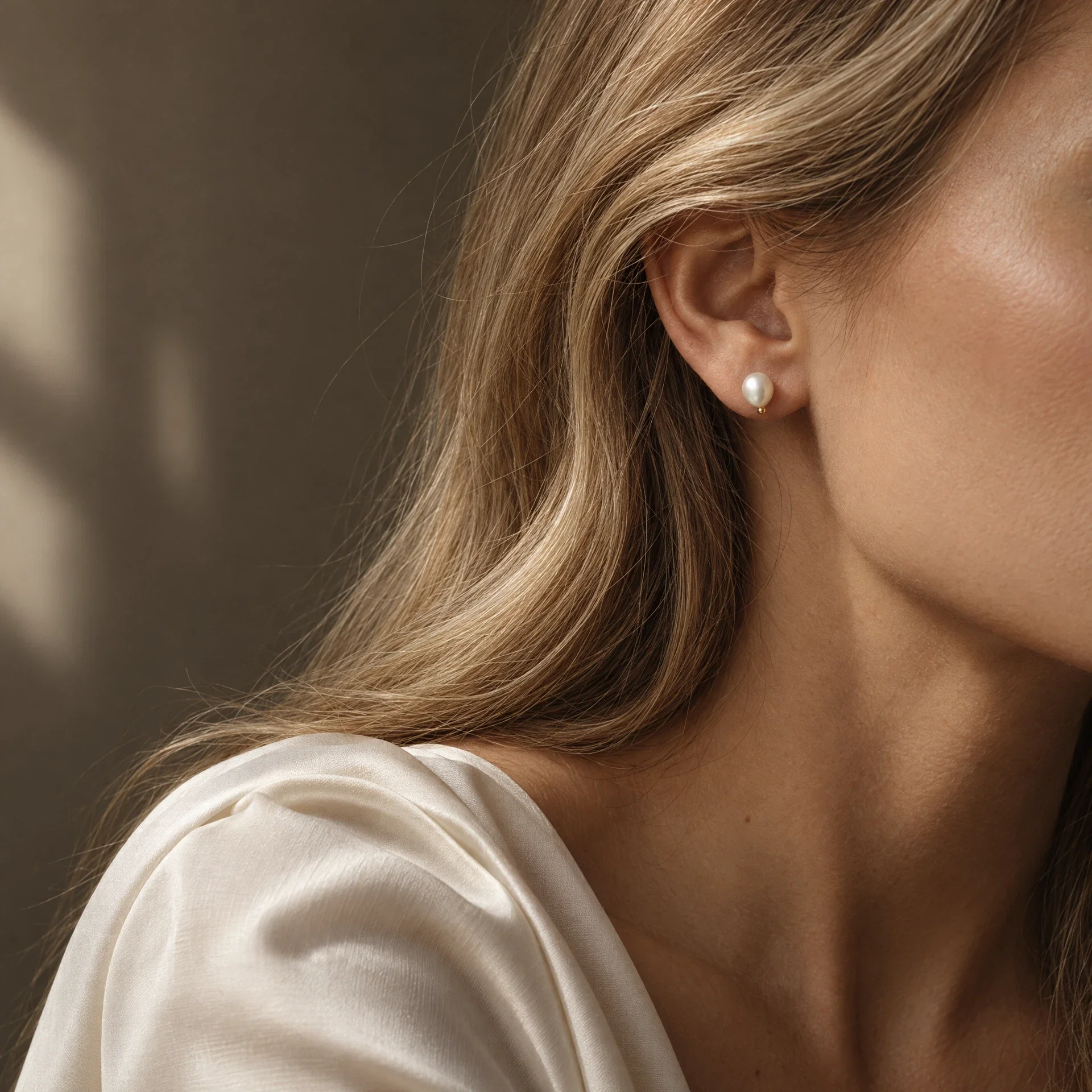
Choosing bridal jewelry is less about completing a prescribed set and more about deciding where you want attention to land. Your dress establishes the largest shapes, your neckline frames the face and chest, and your personality gives the finished look its character. A useful starting question is not “What should a bride wear?” but “Which details make this feel like me?” That shift can prevent an outfit from becoming beautiful but unfamiliar.
Approach bridal jewelry as an editing exercise. Start with the dress, add one piece you genuinely love, and assess whether anything else improves the balance. A necklace, earrings, bracelet, and sentimental ring do not all need equal prominence. Sometimes one expressive pair of earrings does more than a coordinated set. Sometimes a tiny inherited pendant is the right center of attention, even when a larger necklace would fill the neckline more completely.
Read the Dress Before Choosing the Details
The best bridal jewelry responds to what the dress already contributes. Look at the gown from several steps away before examining individual beads or stitches. Does its effect come from a sculptural silhouette, intricate lace, reflective embellishment, or flowing fabric? A heavily decorated bodice already creates many points of interest; simpler jewelry can give the eye somewhere to rest. An undecorated dress leaves more room for texture, color, or a distinctive shape.
Scale matters as much as sparkle. For example, a narrow chain can look intentional with a restrained slip dress but visually disappear beside substantial embroidery. That does not automatically make the chain wrong: it may be a private detail rather than a visible statement. When comparing bridal jewelry, decide whether each piece should register across the room, in close portraits, or mainly to you. Those are three different jobs.
Consider the dress’s lines rather than trying to reproduce every motif. Curved earrings might soften a sharply structured bodice, while a geometric pendant can bring definition to romantic lace. Exact repetition can feel cohesive, but too many matching floral or teardrop shapes may look overly literal. For visual research, the D LOVE JEWELRY collection showcase can help you compare design directions; ask the brand to confirm current details about any piece that interests you.
Color coordination also allows flexibility. White, ivory, champagne, and blush fabrics can reflect differently under daylight and warm indoor lighting. Place prospective bridal jewelry beside a fabric swatch, if you have one, rather than relying only on a phone photograph. Choose the metal tone you enjoy wearing, then check whether its contrast with the dress feels deliberate. Mixing metals can work particularly well when an engagement ring or heirloom already establishes a second tone.
Before buying or borrowing bridal jewelry, identify the dress’s practical obstacles. Raised settings can catch on lace, bracelets may disturb delicate cuffs, and long pendants can shift against a low bodice. A jeweled belt or decorative shoulder fastening may also compete with an additional focal point. These are reasons to test combinations, not rules against ornament. Remove one element at a time and notice whether the remaining details become clearer.
Use the Neckline to Set Shape and Spacing
A neckline creates a boundary, and bridal jewelry should sit comfortably within it or clearly apart from it. With a V-neck, a pendant can echo the opening, provided it does not hover awkwardly against the fabric edge. Try several lengths while wearing the actual dress. A deeper neckline does not require a longer necklace: a shorter piece can create useful separation, while leaving the lower part of the opening uncluttered.
Strapless and sweetheart necklines offer space, but filling that space is optional. A short necklace can emphasize the collarbone; earrings alone can keep the effect open and relaxed. For example, a bride wearing a structured sweetheart gown might choose compact drop earrings and no necklace to preserve the bodice’s curved outline. Another might prefer a delicate pendant because that is what she wears every day. Both choices can produce balanced bridal jewelry.
High necks, halters, and illusion panels often make earrings the easier focal point. A necklace may sit on top of embroidery, interfere with a fastening, or visually fragment a carefully designed panel. Check whether the fabric is sheer, embellished, or fragile before placing anything against it. An off-the-shoulder neckline invites a similar assessment: a necklace can follow its horizontal emphasis, but it should not crowd the dress edge or restrict comfortable movement.
With asymmetrical necklines, bridal jewelry can either reinforce the asymmetry or offer a quiet counterbalance. Keep this intentional rather than accidental. A long pendant may pull attention away from a sculptural one-shoulder detail, while small earrings let that detail remain dominant. If you love substantial earrings, test their width as well as their length. A broad shape can overlap visually with a shoulder bow even when the earrings themselves are not especially long.
Finally, assess bridal jewelry with your planned hairstyle and veil, not in isolation. Hair worn down may conceal small earrings or tangle around intricate shapes. An updo exposes more of the ear and neck, making moderate pieces look stronger. Put on the veil and turn your head slowly to check for catching. If you change hairstyles between ceremony and reception, choose pieces that work in both arrangements or plan a simple, manageable switch.
Let Personality and Meaning Guide the Edit
Your wedding is not a reason to abandon your usual visual language. If you rarely wear necklaces, an unfamiliar statement collar may require more adjustment than you expect. If you enjoy bold color, an entirely pale arrangement might feel unnecessarily cautious. Choose bridal jewelry that stretches your everyday style only as far as you want. Looking polished is compatible with looking recognizable, whether your preference is minimal, expressive, traditional, or a mixture.
Choose one leading detail and give the others supporting roles. For example, colorful earrings might pair with a plain bracelet and your existing rings; an inherited necklace might work best with small studs. Meaningful bridal jewelry does not need to match perfectly to belong. A difference in metal color or era can make the ensemble more personal, provided the shapes and proportions are not all competing for attention at once.
Sentimental pieces deserve consideration without becoming obligations. A family ring may feel welcome on your hand, or it may be more comfortable kept privately nearby. If you are considering a memorial piece, the cremation keepsake information offers a starting point for questions rather than a reason to rush a decision. Before sending any material, obtain written instructions and applicable local information. You do not need to make a deeply personal keepsake part of a public wedding look.
Gifts introduce another layer of choice. When someone offers bridal jewelry, discuss the intended role before settling on a style: wedding-day focal point, discreet keepsake, or something for ordinary wear afterward. Share neckline photographs and preferences with the giver if you are comfortable doing so. Equally, leave room for a gracious conversation when a treasured gift does not suit the dress. Appreciation does not require wearing every meaningful piece simultaneously.
Think beyond the ceremony without making future wear a requirement. Simple earrings or a restrained pendant may fit naturally into your later wardrobe; a dramatic piece may remain a special-occasion favorite. The everyday jewelry showcase can help you explore quieter proportions. Bridal jewelry can be chosen for one remarkable day or for repeated use, but the decision should reflect your priorities rather than an assumed rule about value.
Test Comfort, Clarify Materials, and Plan Care
A dress fitting is the most useful rehearsal for bridal jewelry. Wear the intended pieces long enough to notice weight, pressure, and movement. Sit down, raise your arms, hug someone, and practice any planned dance movements. Check whether a necklace turns, earrings pull uncomfortably, or a bracelet knocks against another piece. Something that looks excellent during a thirty-second mirror check may become distracting over several hours.
Photographs provide a second check, not a final verdict. Take front and side pictures in daylight and under indoor lighting, ideally with the dress or a similarly colored top. Notice reflections near the face, overlap with the neckline, and whether meaningful details remain visible. When reviewing bridal jewelry, avoid judging solely from extreme close-ups: wedding photographs often include your full silhouette, other people, and a busy background. Check that the look works at that distance too.
Clarify materials before deciding how a piece fits your plans. Gold-filled is not the same as solid gold; sterling silver is at least 925/1000 silver, and U.S. vermeil descriptions have specific FTC conditions. A hallmark can offer information, but it is not authenticity proof by itself. For bridal jewelry with plating, delicate stones, or organic or resin-based elements, ask about the actual construction and suitable care. Do not assume similar-looking pieces have identical properties.
Prepare jewelry away from fragrance, cosmetics, and hair products, and put it on after those products have been applied. Chemicals, chlorine, heat, and unsuitable ultrasonic cleaning can harm some jewelry, including pearls, delicate gems, and organic or resin-based pieces. Follow care guidance appropriate to the specific materials rather than a universal cleaning recipe. If bridal jewelry needs cleaning before the wedding, clarify the method in advance rather than improvising on the morning itself.
Keep the final plan simple: list the pieces, check fastenings, and decide where removed items will be kept separately to limit rubbing and tangling. If borrowing, agree on handling and return arrangements with the owner. For questions about a featured design, use D LOVE JEWELRY’s consultation contact page and ask for confirmation of current materials, dimensions, and other relevant details. The goal is a considered combination you can wear comfortably, then stop thinking about.