
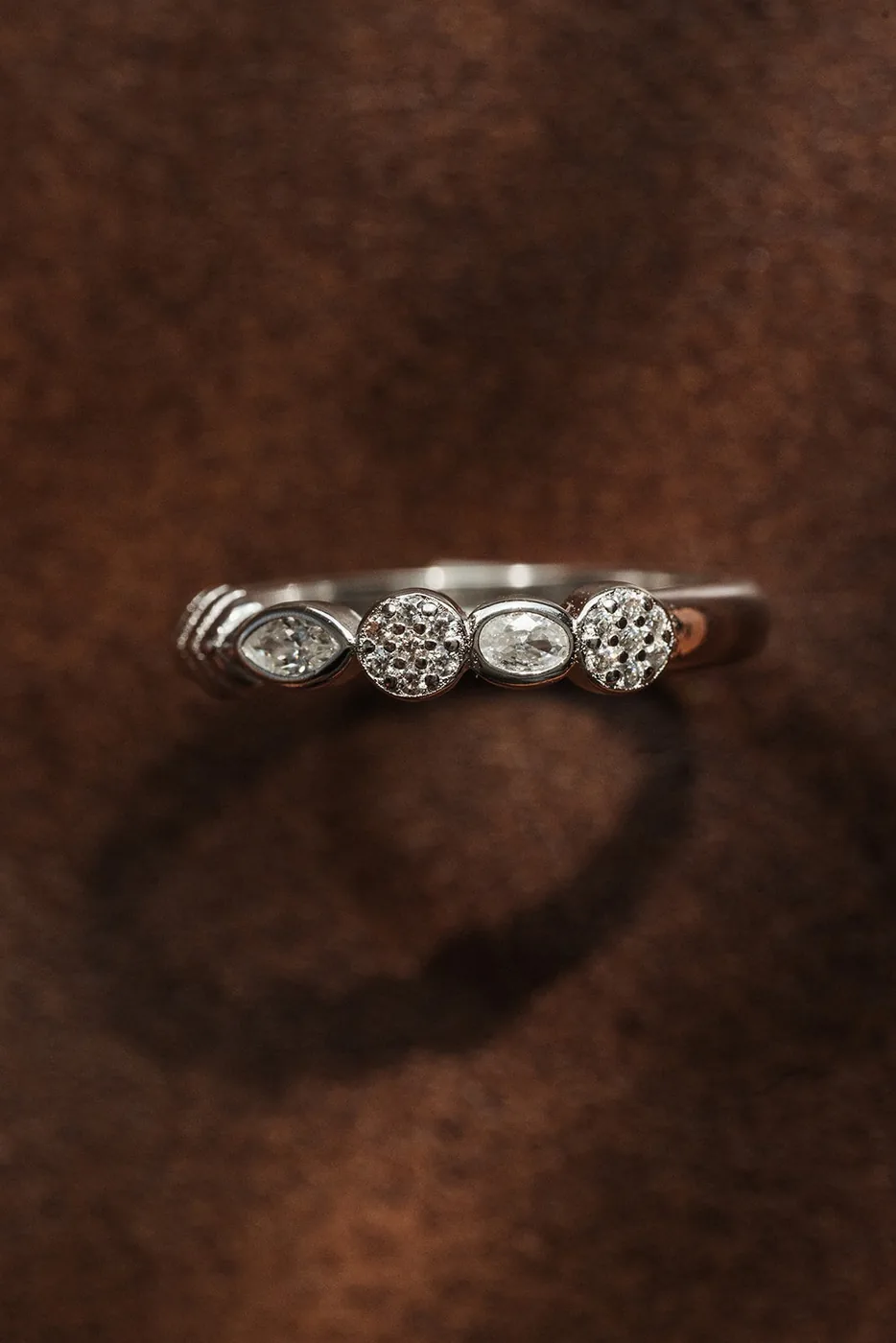
A useful ring size guide starts with one principle: measure the finger you intend to wear the ring on, under ordinary conditions, and check the result more than once. A ring must pass over the knuckle without excessive force, then sit securely at the base of the finger. Those two requirements do not always point to the same size, especially when the knuckle is noticeably wider than the finger below it.
This ring size guide explains what home measurements can tell you, where they become unreliable, and how to turn a rough result into a better-informed decision. You do not need to chase a perfect number on your first attempt. Instead, gather consistent measurements, note the intended band width, and identify any fit complications before committing to a particular size.
1. Measure the Right Finger at the Right Time
The first step in this ring size guide is to define the wearing position. Your left and right ring fingers may differ, even if they look similar. Dominant-hand fingers can also be larger, but do not assume that they are. Measure each relevant finger separately and write down the hand and finger beside every result. A measurement labeled only “ring finger” becomes surprisingly easy to misinterpret later.
Finger size changes with temperature, activity, and ordinary daily fluctuations. Cold hands can give a smaller reading; heat or recent exercise can give a larger one. Measure when your hands feel comfortable and have settled after activity. Repeat the measurement on another day, ideally under similar conditions. Avoid treating a reading taken immediately after a hot shower, an outdoor winter walk, or a strenuous workout as your baseline.
Use this ring size guide to track a small range rather than selecting whichever reading you prefer. For example, if three careful measurements cluster closely and one is distinctly different, check what changed during the outlying measurement. Was the strip pulled tighter? Were your hands unusually warm? Repeat before deciding. If readings remain substantially inconsistent, a physical fitting is more useful than averaging uncertain numbers.
Check the knuckle as well as the base of the finger. A narrow finger with a prominent knuckle may need a compromise: enough clearance to remove the ring, without excessive looseness during wear. This ring size guide cannot settle that compromise from circumference alone. Trying actual sizing rings helps reveal how much resistance feels manageable and whether the ring rotates once it reaches its wearing position.
- Record the hand, finger, date, and measurement method.
- Note whether your hands felt cold, warm, or typical.
- Keep measurements in millimeters to reduce conversion confusion.
- Repeat without pulling the measuring material tighter each time.
Use the ring size guide as a consistency check, not a reason to force a measurement when your finger is unusually swollen or uncomfortable. If a ring causes pain, numbness, or a marked color change, stop wearing it and seek appropriate help; an urgent removal problem is not a sizing-chart exercise.
2. Choose a Home Method and Understand Its Limits
For this ring size guide, the most useful home options are a nonstretch measuring strip, a suitable ring that already fits, or a purpose-made sizing tool. Each measures something slightly different. A strip estimates finger circumference, an existing ring provides inner dimensions, and a sizing tool approximates wearing fit. None is reliable if the final result is matched to an unrelated or inaccurately printed chart.
Using a paper strip
Cut a narrow strip of paper, wrap it around the finger, and mark where the end meets the strip. Keep it flat, comfortably snug, and free from overlap that adds bulk. Measure from the starting edge to the mark with a millimeter ruler. Repeat several times. Avoid stretchy string, elastic, or thread: stretching and digging into the skin can make the result look more precise than it is.
A ring size guide should distinguish circumference from diameter. The paper method gives circumference; measuring across the inside of a ring gives diameter. These are not interchangeable chart columns. If your strip reads 54 millimeters, look for a circumference near 54 millimeters in the intended sizing system, not a diameter of 54 millimeters. The corresponding nominal size may depend on the chart and system being used.
Measuring a ring that already fits
Select a genuinely round ring worn comfortably on the same finger and hand. Measure straight across its inside opening, through the center, excluding the metal walls. An outside-edge measurement overstates the opening. A bent ring, a strongly shaped interior, or a ring that fits another finger is a weaker reference. A ruler can provide an estimate, but small reading errors matter at this scale.
When using a printable ring size guide, print at actual size with scaling disabled, then verify its calibration mark with a ruler. Do not trust circles viewed on a phone screen. If comparing a ring with printed circles, follow that chart’s alignment instructions carefully. When two sizes seem equally plausible, record both rather than choosing one on the strength of a blurry line.
A plastic or metal sizer can improve confidence, but its width and shape should resemble the intended ring. This ring size guide treats home tools as a screening step: they help narrow the question, while a fitting with comparable bands can resolve uncertain results. Avoid forcing a rigid sizer over a difficult knuckle just to obtain a number.
3. Adjust for Band Width, Shape, and Wearing Habits
Fit is not determined by the size label alone. In this ring size guide, band width is a key decision point because a wider band contacts more of the finger and can feel tighter than a narrow one with the same nominal inner size. Some people need a larger size for a broad band, but there is no universal adjustment that works for every finger and design.
For example, someone who comfortably wears a slim two-millimeter band may find a substantially wider band restrictive in the same labeled size. The sensible next step is to try a sizer close to the wider band’s dimensions, not automatically add a fixed half size. Likewise, several narrow rings worn together can feel tighter than one worn alone because their combined contact area changes the experience.
This ring size guide also separates interior profile from exterior appearance. A rounded interior, sometimes described as comfort fit, may move over the knuckle differently from a flatter interior. Thickness and edge shape can affect the feel too. Ask what profile the proposed ring has and whether the sizing recommendation is based on that specific design. A broad, heavy ring should not be judged solely against a delicate reference ring.
Assess fit through ordinary movements: relax your hand, make a gentle fist, and check whether the ring stays reasonably secure. Removal should usually involve some resistance at the knuckle rather than effortless slipping, but the ring should not require painful pulling. A slight impression does not by itself establish poor fit. Persistent discomfort, restricted movement, or pronounced pressure means the choice needs reconsideration.
Use the ring size guide alongside your wearing plans. If you expect to wear the ring next to another band, test that combination where possible. If the design is top-heavy, some rotation may reflect weight distribution rather than an oversized opening alone. Tightening the fit to stop all movement can create a different problem at the knuckle. Discuss alternatives with a qualified jeweler instead of improvising a permanent modification.
While browsing everyday jewelry ideas or the collection showcase, note the designs whose width and profile suit your routine. This ring size guide is most effective when measurements accompany those observations. Comfort during typing, gripping, or frequent handwashing may matter more to you than achieving a completely motionless fit.
4. Confirm the Size Before Making a Decision
The final stage of this ring size guide is verification. Different regions use different labels, including U.S. numbers, U.K. letters, and circumference-based systems. A bare size number can therefore be ambiguous. State the sizing system explicitly and, when available, include the measured inner diameter or circumference in millimeters. Use the chart associated with the ring being considered rather than assuming every conversion chart is identical.
Before relying on resizing later, ask whether the particular design can be altered and what limitations apply. Continuous patterns, stones around the full band, some materials, and special construction can restrict resizing options. Even a design that appears simple should not be assumed adjustable. A ring size guide helps you avoid making reversibility part of your plan without confirmation from the person assessing the actual piece.
For D LOVE JEWELRY, prepare a concise inquiry through the email consultation contact page. Include the intended finger and hand, sizing system, repeated measurements, measurement method, and preferred band width if known. Ask D LOVE JEWELRY to confirm current design details and any relevant sizing or adjustment options. The site is a showcase and consultation resource; browsing a design does not establish its current availability or terms.
If you are considering a meaningful cremation keepsake or breast-milk keepsake, settle fit questions without rushing the wider decision. This ring size guide addresses sizing only. Obtain written instructions and applicable local information before sending any keepsake material, and ask for confirmation of the specific design’s care and adjustment limitations. Do not assume that a keepsake ring can be resized like a plain band.
For a surprise gift, a borrowed ring is useful only when you know which finger it fits and how comfortably it fits there. Guessing from hand appearance or general body size is unreliable. If uncertainty remains, involving the recipient in sizing may be kinder than preserving the surprise. There is no need to turn an important gift into a deadline-driven fit decision.
Keep your final notes after consulting: size system, dimensions, band width, and the conditions under which the fit was checked. Return to this ring size guide if the design changes, since a measurement that suits one band may not suit another. The best result is not merely a plausible number; it is a ring that passes the knuckle safely, feels comfortable in normal use, and has its design-specific questions answered.