
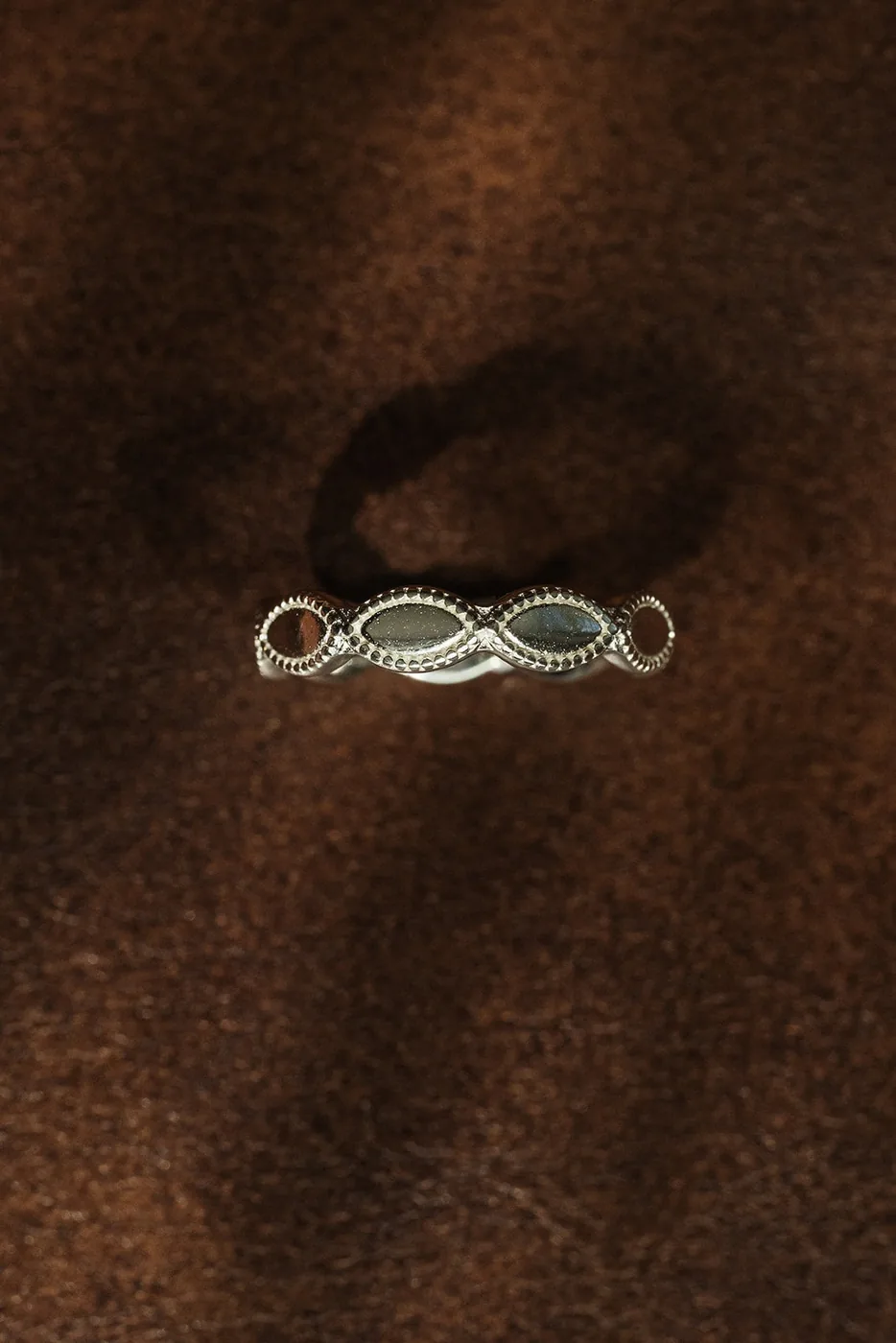
Wearing gold and silver together is not a mistake to disguise. With mixed metal jewelry, the useful question is not whether the colors match, but whether the pieces share a clear relationship. That relationship might be a repeated shape, a similar finish, a balanced size, or simply a gold ring echoed by gold earrings. A small amount of repetition often does more than a large number of accessories.
The goal is a combination that feels intentional without requiring a formula every morning. Mixed metal jewelry can accommodate a silver wedding band, a favorite gold necklace, and a watch you already wear. You do not need to replace meaningful pieces to create uniformity. Start with what stays on, then make a few deliberate choices around it rather than treating every item as equally important.
Choose an Anchor Before You Add Contrast
A reliable starting point for mixed metal jewelry is one anchor: the piece that sets the scale or carries the most visual weight. It could be a broad silver cuff, a substantial gold pendant, or a watch with a prominent case. Choose it before adding anything else. If several pieces compete to be the anchor, the combination can feel crowded even when there are only three items.
Next, decide whether one color should lead. Mixed metal jewelry does not need a fifty-fifty split; a mostly silver arrangement with one gold accent can look clearer than an evenly divided collection. Think in visible surface area rather than item count. One wide gold bangle may contribute more gold than three fine silver rings contribute silver. Look at the whole arrangement from a normal conversational distance.
For example, a silver watch and slim silver ring can establish a cool-toned base, while small gold hoops provide contrast near the face. To connect mixed metal jewelry across the body, you might add a narrow gold ring on the opposite hand. That second gold note is optional, but it can make the earrings feel less isolated. The aim is a visual echo, not compulsory symmetry.
Your anchor can also be sentimental rather than large. A small pendant you wear every day deserves to stay in the plan, even if its color differs from everything else. Let mixed metal jewelry frame that piece with quieter shapes and fewer competing details. The everyday jewelry showcase can be a place to consider visual directions; ask D LOVE JEWELRY to confirm materials and current details for anything that interests you.
- For a quiet result: use one dominant metal and one small contrasting accent.
- For a balanced result: repeat each metal in two visible areas, such as ears and hands.
- For a bold result: keep shapes simple so contrast and scale carry the look.
- For an uncertain result: remove the least meaningful piece and reassess before adding another.
Build Connections Through Shape, Finish, and Placement
Color is only one part of coordination. Mixed metal jewelry often looks cohesive when pieces share a design language: rounded links, clean geometric edges, fine chains, or softly irregular surfaces. A polished gold hoop and a polished silver bangle can relate through smooth curves even though they sit far apart. Conversely, matching metal colors will not necessarily unite sharply different proportions, textures, and levels of ornament.
Finish changes how strongly the contrast reads. High-polish surfaces reflect surrounding colors and create bright highlights; brushed or matte surfaces tend to appear quieter. For restrained mixed metal jewelry, try similar finishes first. For more contrast, pair a polished accent with a subdued base. Neither approach is inherently better, but combining different colors, finishes, shapes, and sizes all at once gives the eye more information to organize.
Placement provides another connection. In mixed metal jewelry, repeating a tone near the face and on a hand can feel more integrated than concentrating every gold piece on one side and every silver piece on the other. Asymmetry still works: a gold earring pair, a silver necklace, and a two-tone watch can create a loose visual triangle. Check the effect with your usual posture, not only with your hands arranged for a photograph.
A piece containing both tones can serve as a bridge, but it is not required. When considering such an element for mixed metal jewelry, notice which color occupies more space and whether its scale suits your existing pieces. A large two-tone necklace may overwhelm delicate rings rather than unite them. Use the collection showcase to compare visual themes, without assuming that any pictured design is currently available.
Let clothing support the combination
A plain knit, open collar, or simple sleeve gives contrasting metals room to register. Patterned fabric and decorative buttons already introduce visual rhythm, so fewer accessories may be enough. Belt buckles, bag hardware, and eyeglass details do not all have to match. Treat them as background unless they are especially prominent. If a large buckle becomes another focal point, simplify the jewelry nearest it.
Make Rings, Necklaces, and Bracelets Work in Motion
Rings are an accessible place to try mixed metal jewelry because you can adjust the arrangement one finger at a time. Begin with a familiar band, then add a contrasting ring with comparable visual weight. Leave an empty finger or a little space if the grouping looks compressed. Broad rings next to narrow ones can be effective, but comfort and unrestricted movement matter more than a tidy photograph.
For necklaces, separate the pendants as well as the chains. Mixed metal jewelry loses definition when two focal pieces repeatedly overlap. As an example, a short silver chain without a pendant can sit above a longer gold chain carrying a small charm. Test the combination while turning your head, bending forward, and sitting down. Different lengths can help, but they do not guarantee that chains will remain untangled.
Bracelets need particular attention because they move and contact one another. A loose silver chain beside a rigid gold bangle may look appealing, yet repeated rubbing can mark surfaces or affect a delicate finish. With mixed metal jewelry, spacing pieces on opposite wrists is a useful alternative to stacking. Leave a cherished watch some breathing room, especially if a neighboring bracelet strikes its case whenever you type.
Weight and routine should guide the final edit. Mixed metal jewelry that feels manageable during a brief fitting may be distracting through a working day. Check whether earrings pull, bracelets catch on sleeves, or rings interfere with gripping a bag. Before considering an additional piece from the product showcase, identify the actual gap: a small gold accent, a simpler silver shape, or a lighter alternative to an existing statement piece.
A practical three-piece trial
- Keep one piece you regularly wear, such as a silver band.
- Add a gold piece in a different area, such as understated earrings.
- Choose one connecting element, such as a necklace whose rounded shape echoes the earrings.
- Wear the combination during an ordinary activity, then remove anything that feels visually or physically unnecessary.
This trial helps distinguish a styling problem from a comfort problem. If the colors feel disconnected, repeat a shape or finish. If the pieces keep touching, change placement. If the arrangement simply feels too busy, reduce the number of focal points. Buying another accessory is not the only solution, and often it is not the first one worth trying.
Understand Materials and Keep Care Piece-Specific
The visible colors in mixed metal jewelry do not tell you exactly what the pieces contain. A gold-colored item might be solid gold, gold-filled, plated, or another material with a gold-toned finish. Gold-filled is not the same as solid gold. Sterling silver is at least 925 parts per thousand silver, while vermeil descriptions have specific U.S. FTC conditions. These distinctions matter when comparing materials and discussing suitable care.
A stamp can provide a useful clue, but it is not authenticity proof by itself. Before adding an unfamiliar piece to mixed metal jewelry, seek a clear material description, including any plating and the material beneath it. If a listing leaves something uncertain, ask rather than infer from color or a photograph. Surface treatments can change appearance, and different gold alloys can have visibly different shades.
Care for mixed metal jewelry according to its most sensitive component, not according to the toughest metal present. Chemicals, fragrance, chlorine, heat, and unsuitable ultrasonic cleaning can harm some jewelry, including pearls, delicate gems, and organic or resin-based elements. Do not assume that a silver cleaning dip is appropriate for a gold-and-silver piece containing other materials. Obtain material-specific guidance before using cleaners, soaking, or attempting tarnish removal.
Storage also deserves attention: keep pieces separated so chains do not knot around rings and harder surfaces do not rub delicate finishes. A meaningful keepsake can belong in mixed metal jewelry without being stacked against other pieces. If you are considering a cremation or breast-milk keepsake, decide whether you want it to lead the arrangement or sit quietly within it. Before sending anything, request written instructions and applicable local information through D LOVE JEWELRY's consultation contact page.
The most useful finishing check is simple: does the arrangement have one clear focal point, a believable connection between colors, and enough space for comfortable movement? Take away one item and compare. Keep the version that feels more natural, even if it is less symmetrical. Intention comes from choosing what each piece contributes, not from making every metal color appear in equal amounts.