
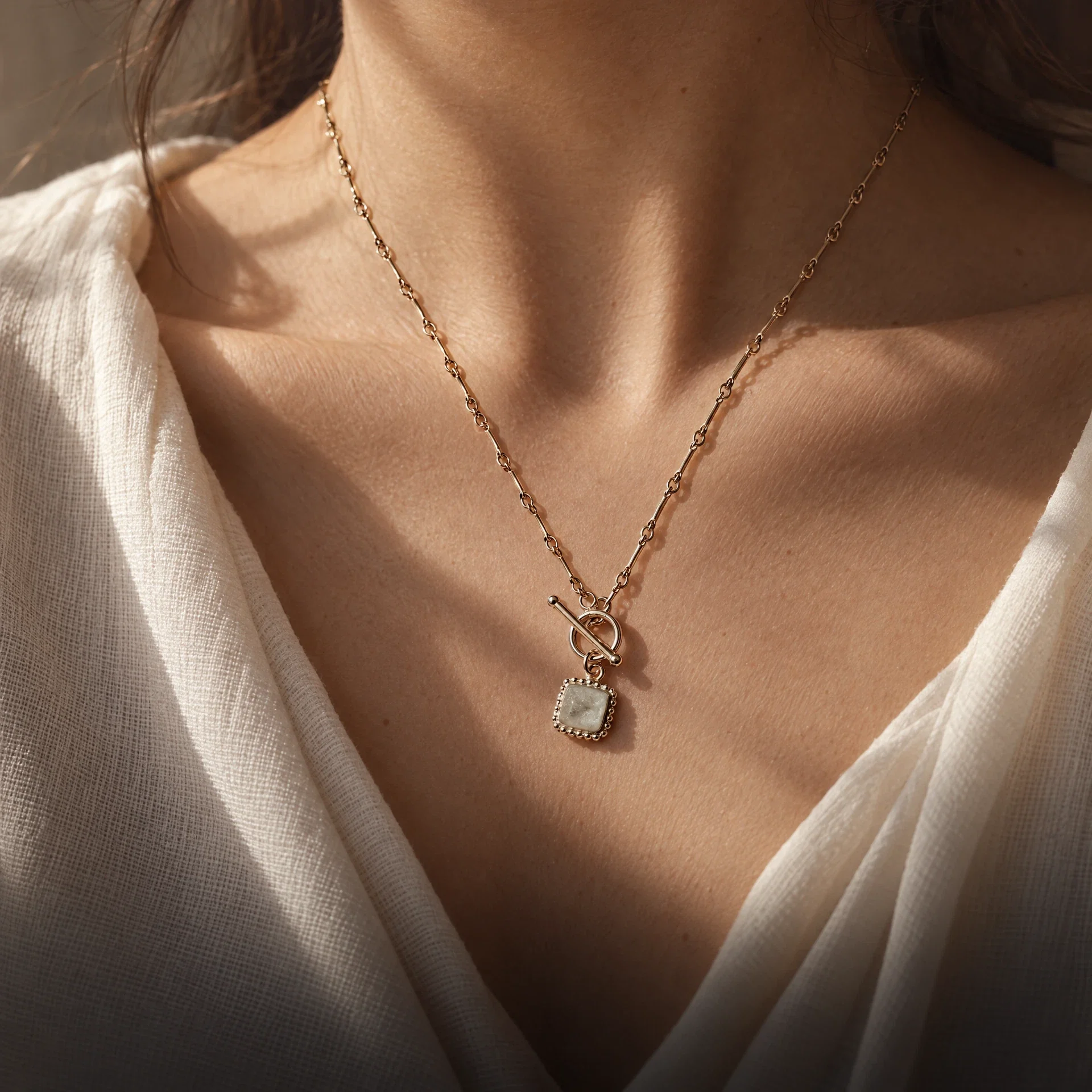
Choosing personalized memorial jewelry can bring together a name, a familiar phrase, or a small reminder of someone important. Before discussing an order, it helps to separate what you want the piece to mean from what its construction must do. A meaningful design still needs readable lettering, comfortable proportions, appropriate materials, and clear instructions for anything you may entrust to a maker.
You do not need to settle every question at once. A sketch, a saved handwriting sample, or a short list of preferences can be enough to begin exploring personalized memorial jewelry. D LOVE JEWELRY is a showcase and email-consultation site; ask the team to confirm current options and arrangements rather than assuming that a displayed design can be purchased or customized exactly as shown.
Start with the remembrance, not the decoration
The first question is simple: what should this object help you remember? For personalized memorial jewelry, the answer might be a person's full name, their handwriting, a shared place, or a private expression. These choices lead to different layouts. A full name needs space; a tiny symbol may be discreet; handwriting may require enough surface area to retain its recognizable character.
Ask who will wear the piece and how public the remembrance should be. Some people want an inscription visible to others, while others prefer a message facing the body. With personalized memorial jewelry, neither approach is more meaningful. For example, initials on the front and a short date on the reverse can balance recognition with privacy, if that layout is feasible.
Consider whether the design should represent one person or several. Adding names later may not be possible without altering the layout or replacing a component. If you anticipate another inscription, ask whether space can be reserved and whether future work would require a fresh assessment. Do not rely on the assumption that any blank area will accept engraving.
Before choosing wording for personalized memorial jewelry, write it exactly as you want it to appear, including capitalization, accents, punctuation, and date format. A date such as 04/06 can mean different things in different countries. Writing the month in letters may reduce ambiguity, although it uses more space. Ask how special characters and non-English lettering would be represented.
If the piece is intended as a gift, ask permission before using someone else's treasured handwriting or arranging an inclusion keepsake. A recipient may prefer to choose the design themselves, or may not want jewelry at all. Offering to discuss possibilities together can be kinder than presenting a finished object with an expectation that it will be worn.
Your initial brief for personalized memorial jewelry can stay short: the remembrance, the intended wearer, a preferred jewelry type, and any details that must remain private. Distinguish essentials from flexible preferences. For example, preserving a handwritten signature might matter more than pendant shape. The collection showcase can help you describe a visual direction without treating any example as confirmed availability.
Ask how the materials and proportions will work
Material descriptions deserve careful questions when evaluating personalized memorial jewelry. Ask for the metal name, fineness where applicable, any surface coating, and the materials used in the chain, clasp, and pendant attachment. Different components may have different compositions. A general description such as “gold tone” tells you about appearance, not necessarily the underlying metal or the thickness of a surface layer.
For personalized memorial jewelry described using U.S. terminology, solid gold and gold-filled are not interchangeable. Sterling silver contains at least 925 parts per thousand silver, while vermeil descriptions have specific FTC conditions. Ask for a clear written material description rather than interpreting a stamp alone. A hallmark can be useful information, but it is not independent proof of authenticity.
Think about proportion as well as style. Request dimensions in millimeters and ask whether measurements include the loop or bail. A pendant photographed close up can look much larger than it is. As an example, mark the stated outline on paper and hold it against your clothing to judge whether it feels discreet, prominent, or too small for the planned inscription.
Readability is a practical limit for personalized memorial jewelry. Ask how many characters fit comfortably, not merely how many can technically be placed on the surface. Script lettering may need more space than simple block lettering. A long quotation can become difficult to read on a small charm; using a meaningful fragment may preserve the message better than compressing every word.
Comfort also depends on edges, weight, movement, and attachment details. Ask whether a pendant can rotate, whether its reverse surface rests smoothly against clothing, and whether the chain can pass through the opening you are considering. If you have known sensitivities, ask about all components and seek appropriate individual guidance; no material description should be treated as an allergy guarantee.
Match personalized memorial jewelry to the wearer's actual routine. Someone who works with their hands may find a pendant more practical than a ring, while someone who avoids necklaces may prefer another form. Ask which activities require removal and what limitations apply to the proposed design. The everyday jewelry showcase can provide visual context for comparing understated shapes and proportions.
Clarify approvals and any irreplaceable inclusions
Before committing to personalized memorial jewelry, ask what you would review and approve in writing. A text transcription, layout image, and dimensions answer different questions. Confirm whether any preview is representative or intended to show the final positioning accurately. If handwriting is involved, ask whether it would be reproduced as supplied or interpreted into a different line style.
A useful approval checklist for personalized memorial jewelry should cover more than spelling. Ask which details become fixed after approval and how a requested change would be assessed. Confirm the current arrangements directly with D LOVE JEWELRY; do not assume that revisions, cancellations, or remaking a piece are included. These questions are about understanding the proposed agreement, not anticipating a problem.
- Does the written wording match your source exactly?
- Are the front, reverse, and orientation clearly identified?
- Are dimensions, materials, and attachment details recorded?
- Are uncertain details resolved before you give approval?
If ashes or another irreplaceable material might be involved, first ask whether the proposed design is intended to contain that material at all. A memorial inscription and an inclusion keepsake are different constructions. Viewing the cremation remembrance information can help frame the conversation, but it should not replace written confirmation about the specific piece being discussed.
For inclusion-based personalized memorial jewelry, obtain written instructions before collecting, preparing, or sending anything. Ask who would receive the material, how it would be identified, what happens to any unused portion, and whether handling involves another party. Seek applicable local information about transport or mailing restrictions. Do not infer suitable quantities, packaging, or an address from photographs or informal descriptions.
Similar care is needed if breast milk is being considered for a remembrance or family keepsake. Ask whether that option is currently offered, what written preparation instructions apply, and what limitations the finished material would have. The breast-milk keepsake information is a starting point for questions, not a basis for assuming a preservation method, storage life, or durability.
There is no obligation to use an irreplaceable inclusion in personalized memorial jewelry. An engraved name, a reproduced handwritten word, or a chosen symbol may express the remembrance without transferring anything precious. If you are uncertain, pause. Keeping the original material safely with you while exploring alternatives is a valid decision, and the design conversation can remain separate from any decision to proceed.
Confirm care, practical arrangements, and a comfortable pace
Ask for care guidance specific to personalized memorial jewelry rather than relying on a general cleaning routine. Chemicals, fragrance, chlorine, heat, and unsuitable ultrasonic cleaning can harm some metals, pearls, delicate gems, and organic or resin-based elements. A method suitable for one component may be unsuitable for another. Clarify whether the complete piece can be cleaned together and which products should be avoided.
Daily wear does not mean unrestricted wear. For personalized memorial jewelry, ask about bathing, swimming, exercise, sleeping, and exposure to cleaning products. Find out what signs should prompt removal and professional assessment, such as a loose attachment or damaged closure. Avoid experimenting with polishing compounds or immersion cleaning when you do not know how the setting, coating, or inclusion responds.
Storage deserves a question too: should the piece be kept separately to limit rubbing, and are there special restrictions for its materials? Ask how an unworn piece should be supported so that a chain is not tangled or strained. Written guidance is particularly useful when the jewelry has several materials with different care needs or when someone else may eventually care for it.
Before arranging personalized memorial jewelry, request current details about cost, approval stages, estimated completion, delivery arrangements, and what happens if the result differs from the agreed specification. Ask which estimates depend on unresolved design choices. If a remembrance date matters, say so early, but do not treat an estimate as a guarantee. Waiting may be preferable to accepting a rushed or unclear plan.
Keep a copy of the agreed inscription, dimensions, material description, and relevant correspondence. Also ask how personal photographs or handwriting files would be handled and whether they would be retained. Share only what is needed to explain the design. Use the D LOVE JEWELRY consultation contact page to ask for current details before sending sensitive files or making assumptions about arrangements.
The strongest decision about personalized memorial jewelry is one you can explain in ordinary terms: this detail matters, this form suits the wearer, and these limitations are understood. You may choose a simpler inscription, defer an inclusion, or decide not to proceed. A careful consultation should leave you better informed and free to choose a pace that feels appropriate.