
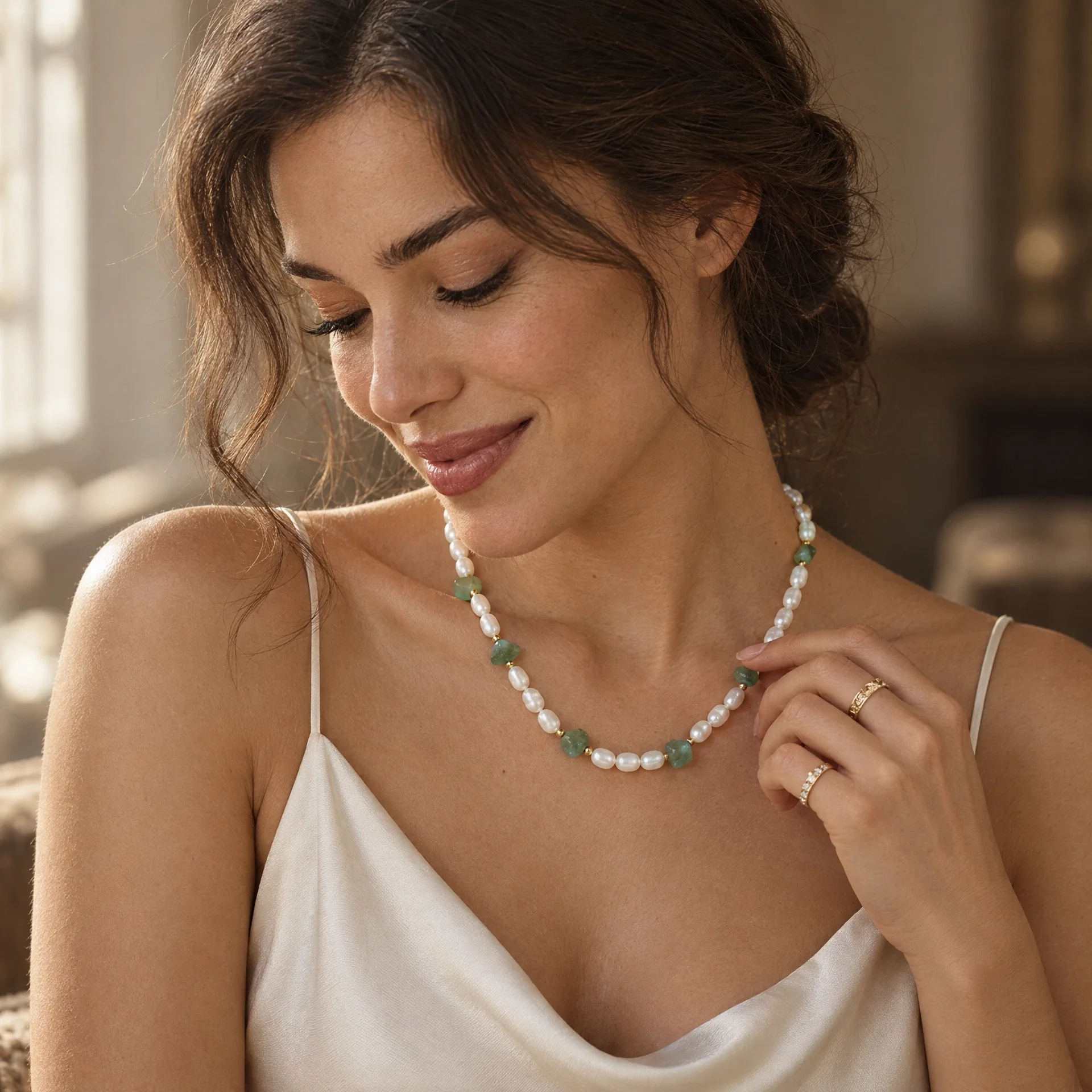
The first impression of a piece usually comes from its color, sparkle, or silhouette. Yet jewelry craftsmanship becomes more important after that first look: when a ring catches on clothing, a pendant turns against the chest, or a clasp proves difficult to close. Construction affects how a piece behaves, not simply how it photographs. A useful assessment therefore looks beyond decoration to the connections between materials, proportions, finishing, and intended wear.
You do not need specialist equipment to begin evaluating jewelry craftsmanship. Careful observation, a few practical questions, and an honest account of your daily routine can reveal a great deal. Some important details remain hidden, however, and appearance alone cannot establish metal composition or long-term reliability. The goal is not to find a flawless object, but to understand its strengths, limitations, and maintenance needs before deciding whether it suits you.
What Jewelry Craftsmanship Reveals Up Close
Start with the surfaces that touch skin and clothing. The underside of a ring, the back of a pendant, and the edges of an earring deserve as much attention as the front. Look for unintended sharp edges, rough transitions, and areas that seem unfinished. Texture may be deliberate, but a textured exterior does not explain an abrasive inner edge. If inspection is limited to photographs, request clear views from several angles.
Good jewelry craftsmanship often shows in transitions rather than dramatic details. A setting should meet its supporting structure coherently; a bail should have enough room for the intended chain; a clasp should connect without an obviously strained link. These observations do not prove structural strength, but they identify sensible questions. Ask whether a connection is fixed, articulated, or designed to move, and what maintenance that arrangement may require.
For example, compare two similarly sized pendants. One may have a narrow bail that restricts chain movement, while another allows the pendant to settle more freely. Neither arrangement is automatically wrong. A restrained design might intentionally reduce movement. What matters is whether the structure supports the intended effect without creating an awkward wear point or preventing the use of the chain you expect to pair with it.
Settings deserve particular attention because jewelry craftsmanship must balance visibility with protection. Raised prongs can expose more of a stone and allow light around it, but they can also catch on fabrics. A bezel surrounds the edge more fully, yet changes the appearance and may conceal details you want to see. Ask how the stone is secured and whether the setting is appropriate for its characteristics and your routine.
Symmetry is another useful clue, although it needs context. A deliberately irregular organic design should not be judged like a geometric solitaire. Instead, look for consistency within the design: repeated elements that align as intended, stone spacing that appears purposeful, and joins that do not interrupt the visual rhythm. Distinguish expressive variation from details that appear accidental.
Ultimately, jewelry craftsmanship is not synonymous with a mirror finish. Matte, brushed, hammered, and high-polish surfaces can all be well executed. Their practical differences matter: polished surfaces may show fine scratches readily, while textured finishes can collect residue or change with wear. Ask how the finish is maintained and whether restoring it could alter nearby details.
Match Construction to the Way You Wear Jewelry
The best design for occasional evenings may not be the best design for frequent wear. Jewelry craftsmanship should be considered alongside hand use, clothing, exercise, and the occasions when you can safely remove a piece. A tall ring may be visually striking but inconvenient under gloves. A long pendant may move more than you prefer during an active day. Suitability is a relationship between object and wearer, not a universal ranking.
Weight also involves tradeoffs. A heavier piece can feel substantial, but extra weight does not independently prove quality. Hollow construction can reduce weight, while thin sections may need more careful handling. An earring that looks modest may still feel uncomfortable after several hours. Where trying something on is not possible, ask for dimensions and weight, and compare them with a piece you already wear comfortably.
Comfort is one of the least photogenic benefits of jewelry craftsmanship. A ring's inner profile, an earring's balance, and a pendant's back shape can change the wearing experience considerably. Fit matters too: a ring that rotates may expose a raised setting to knocks, while an overly tight fit can be uncomfortable. Confirm what sizing information is needed rather than assuming a familiar size will suit every design.
Closures are worth evaluating as working components. Consider whether you can operate a clasp independently, whether an earring closure feels secure without excessive pressure, and whether a bracelet connection is easy to check. No clasp removes every risk of loss. Ease of use and security may compete, especially with very small components, so ask how the closure functions and what signs of wear should prompt inspection.
For jewelry craftsmanship to deliver practical value, the piece must fit the situations in which you will actually wear it. Someone who frequently handles tools may prioritize a low profile and remove rings during work. Someone choosing an occasional statement piece may accept more movement or weight. Use the everyday jewelry showcase to consider design directions, then ask D LOVE JEWELRY to confirm relevant specifications for any piece that interests you.
A useful comparison isolates one difference at a time. Compare setting height, then edge comfort, then closure operation rather than letting overall sparkle decide everything. This makes jewelry craftsmanship easier to assess without assuming that the most elaborate design is the most appropriate. Sometimes a simpler form better supports your priorities; sometimes an intricate design is worth the additional care.
Understand Materials Before Choosing a Care Routine
Material identification sets the boundaries for care. Jewelry craftsmanship cannot make every metal, gemstone, coating, or inclusion tolerate the same treatment. Ask for the metal description, whether the surface is plated or otherwise treated, and what stones or other materials are present. A piece combining several materials generally needs care suited to its most vulnerable component, not just its strongest one.
In U.S. materials guidance, sterling silver is at least 925 parts per 1,000 silver. Gold-filled is not solid gold, and vermeil descriptions have specific Federal Trade Commission conditions. Such terms describe meaningful differences, but they do not answer every construction question. A hallmark can be useful information; it is not, by itself, proof of authenticity. Request a clear written material description when the distinction matters to your decision.
Surface treatments illustrate why jewelry craftsmanship and maintenance belong in the same conversation. Plating may change appearance and can wear over time, particularly at areas exposed to friction. A substantial underlying structure does not prevent its surface from changing. Ask what finish is present, whether restoration is feasible, and what limitations apply. Do not assume that every finish can be renewed without affecting stones or other components.
Care should remain conservative until the materials are confirmed. Chemicals, fragrance, chlorine, heat, and unsuitable ultrasonic cleaning can harm some jewelry, including pearls, delicate gems, and organic or resin-based pieces. Do not treat a home ultrasonic cleaner as a universal solution. The GIA guidance on caring for jewelry offers useful general context, but a specific piece may need more restrictive instructions.
For sentimental pieces, jewelry craftsmanship should be discussed with particular attention to the complete construction. A decorative frame and its central keepsake material may have different sensitivities. If exploring cremation keepsake jewelry or breast-milk keepsake jewelry, request written handling and care instructions. Before sending anything, obtain the applicable local information and confirmed instructions; general jewelry advice cannot replace them.
Practical storage also supports jewelry craftsmanship by reducing avoidable abrasion and tangling. Keep pieces separated, avoid pulling knotted chains forcefully, and check for loose elements before wear. Cleaning frequency should follow condition and material guidance rather than a rigid schedule. If a stone moves, a prong catches, or a clasp behaves differently, stop wearing the piece until its condition can be assessed.
Ask About Maintenance and Repair Before Deciding
A long-term view of jewelry craftsmanship includes what happens when a piece needs attention. Not every design can be resized, refinished, or repaired in the same way. Continuous stone settings, delicate patterns, mixed materials, and certain surface treatments can restrict the options. Ask about feasibility rather than assuming that a familiar repair will be straightforward on an unfamiliar construction.
For example, resizing a patterned band may interrupt its design, and repairing a fine chain may leave a visible change at the join. These are possibilities, not predictions about a particular piece. A thoughtful answer should explain the relevant limitations and distinguish routine maintenance from work requiring individual assessment. An honest limitation can be more useful than a broad promise of easy restoration.
When discussing jewelry craftsmanship, ask questions that produce specific answers:
- What are the stated materials and surface treatments?
- Which components need regular observation for wear or loosening?
- What cleaning methods should be avoided?
- Could sizing or repair affect the design, finish, or included materials?
- Which details need individual assessment before advice can be given?
Use D LOVE JEWELRY's email consultation contact page to clarify current details about a design. Do not infer manufacturing methods, service availability, or policies from photographs. The value of evaluating jewelry craftsmanship lies partly in separating what you can observe from what must be confirmed. Save relevant written answers so that later care decisions are based on the actual piece rather than memory.
Finally, judge the whole object against your priorities. A beautiful piece can still demand care you do not want to provide, while a restrained design may feel right every day. Jewelry craftsmanship matters beyond the first impression because it connects appearance with use, upkeep, and informed expectations. Choose with those connections in mind, leaving room for both personal meaning and practical limits.